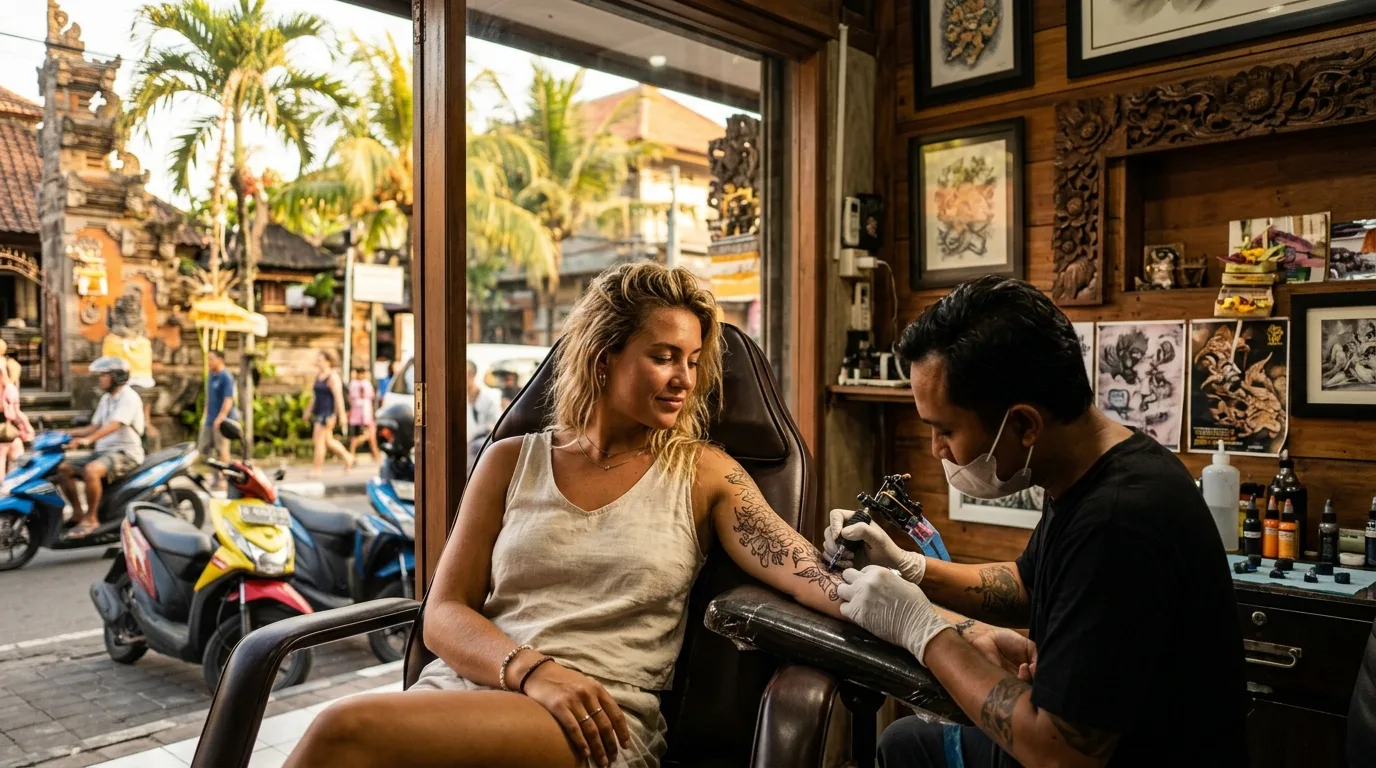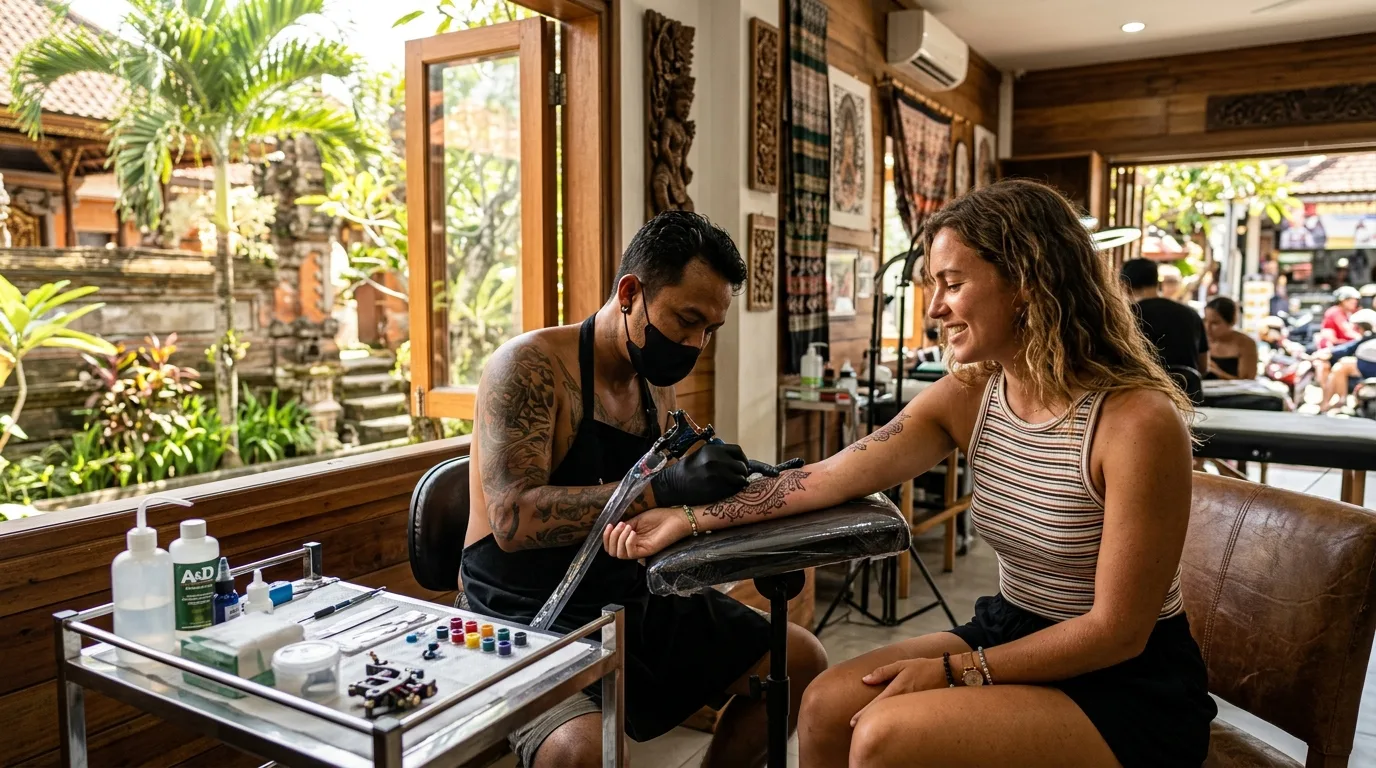
Kuta is one of the better places in Southeast Asia to get tattooed. The concentration of skilled artists is high, and the range of styles has grown well beyond the generic wave-and-palm-tree flash that used to define Bali tattoos.
It isn't the cheapest option. The studios worth visiting aren't the cheapest ones. What you get instead is choice.
Black and grey realism, geometric dotwork, Japanese-influenced pieces, neo-traditional colour work: it's all here, within walking distance of Kuta Beach Walk. New to the idea? See why a Kuta tattoo is worth it and browse tattoo ideas and prices.
I send guests to tattoo studios regularly. I've been to the ones worth recommending and walked out of plenty that aren't.
This guide covers the styles you'll actually find in Kuta in 2026, where to look, what it costs, and what to check before you sit down. The goal is simple: don't spend the second half of your holiday regretting a rushed decision made on Poppies Lane.
Why Kuta for a tattoo?
Kuta has a lot of tattoo studios packed into a small area. That means artists compete on quality and travellers have real choice.
The area around Kuta Beach Walk is an open-air mall right on the beach. Several studios there have been operating long enough to have built reputations worth checking. Seminyak, just across the border, attracts more specialist artists for complex custom briefs.
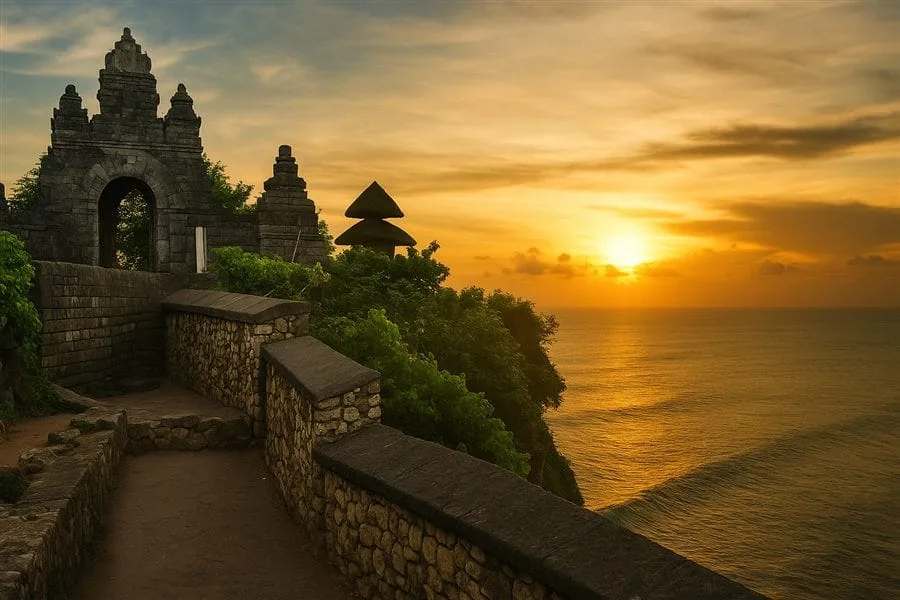
Bali's relationship with body art runs deep. The island has its own visual language: lotus flowers, Barong masks, the Garuda bird, and sacred geometry drawn from Balinese Hinduism.
That heritage influences the artists here even when they're not doing explicitly Balinese work. A black and grey realism piece done by an artist who grew up surrounded by intricate temple carving tends to carry a different quality of detail than the same style done elsewhere.
Kuta is close to Ngurah Rai International Airport (DPS), so it's almost always your first or last stop in Bali. If you're getting tattooed, do your surfing and swimming first and book it for the last couple of days of your trip, not the morning you fly. A fresh tattoo has to stay out of the sea and pool for at least 2 weeks, and a long-haul flight in a dry cabin isn't ideal either, so follow your artist's aftercare instructions.
Tattoo styles you'll actually see
The range has expanded significantly. Here's what you'll realistically find at studios in the Kuta and Seminyak area:
Black and grey realism
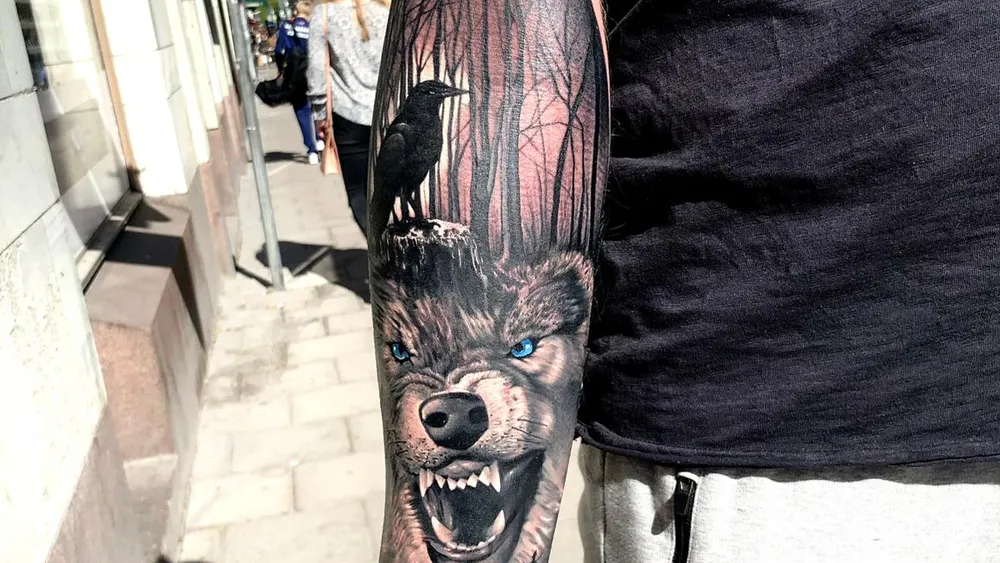
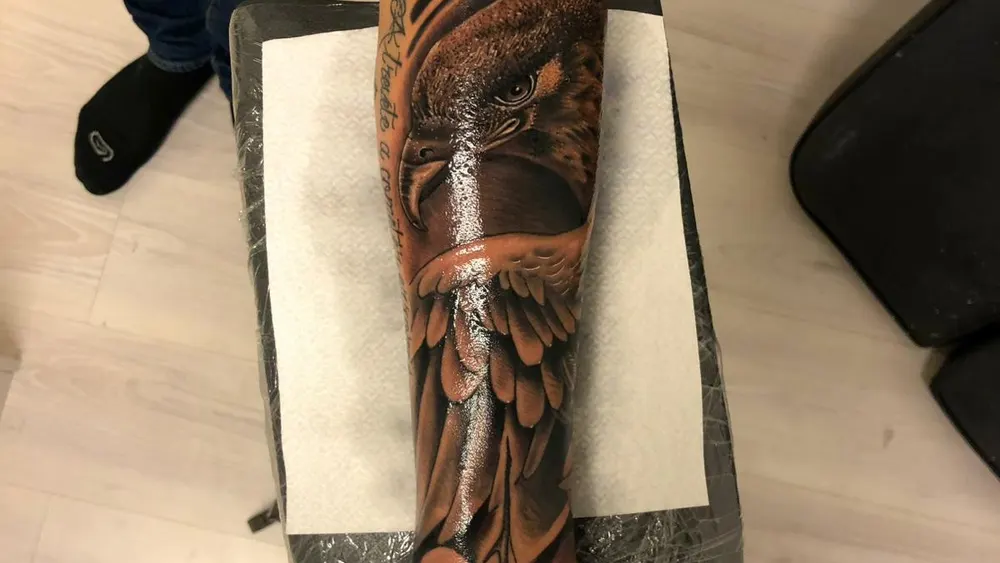
Black and grey realism is the strongest style on offer in Kuta right now. Think eagles, tigers, wolves, and portraits: detailed, shaded, technically demanding work.
The best artists here produce results comparable to strong work in Europe or Australia. It's also the style that most rewards going to the right studio, because poor technique on a realism piece is immediately obvious.
A forearm sleeve in black and grey realism runs USD $300–600 depending on coverage and the artist's session rate.
Geometric dotwork and sacred geometry
Geometric dotwork is the style most influenced by Balinese temple art. It covers mandalas, sacred geometry grids, flower-of-life patterns, and combinations of geometric structure with organic elements like roses or lotuses.
A full leg sleeve in this style is one of the most ambitious pieces you can commission in Kuta. It requires multiple sessions and an artist with patience for the repetition.
A full leg sleeve in dotwork runs USD $500–900 across two to three sessions.
Japanese-influenced work
Japanese-influenced work in Kuta covers koi fish, waves, eagles with cloud and wind-bar fill, and back pieces. The Japanese style translates well to Balinese aesthetics, because both traditions value large-scale, narrative body art.
Back pieces and thigh pieces in this style are some of the most dramatic work available in Kuta. Budget USD $600–1,000 or more for a full back piece across multiple sessions.
Neo-traditional and colour work
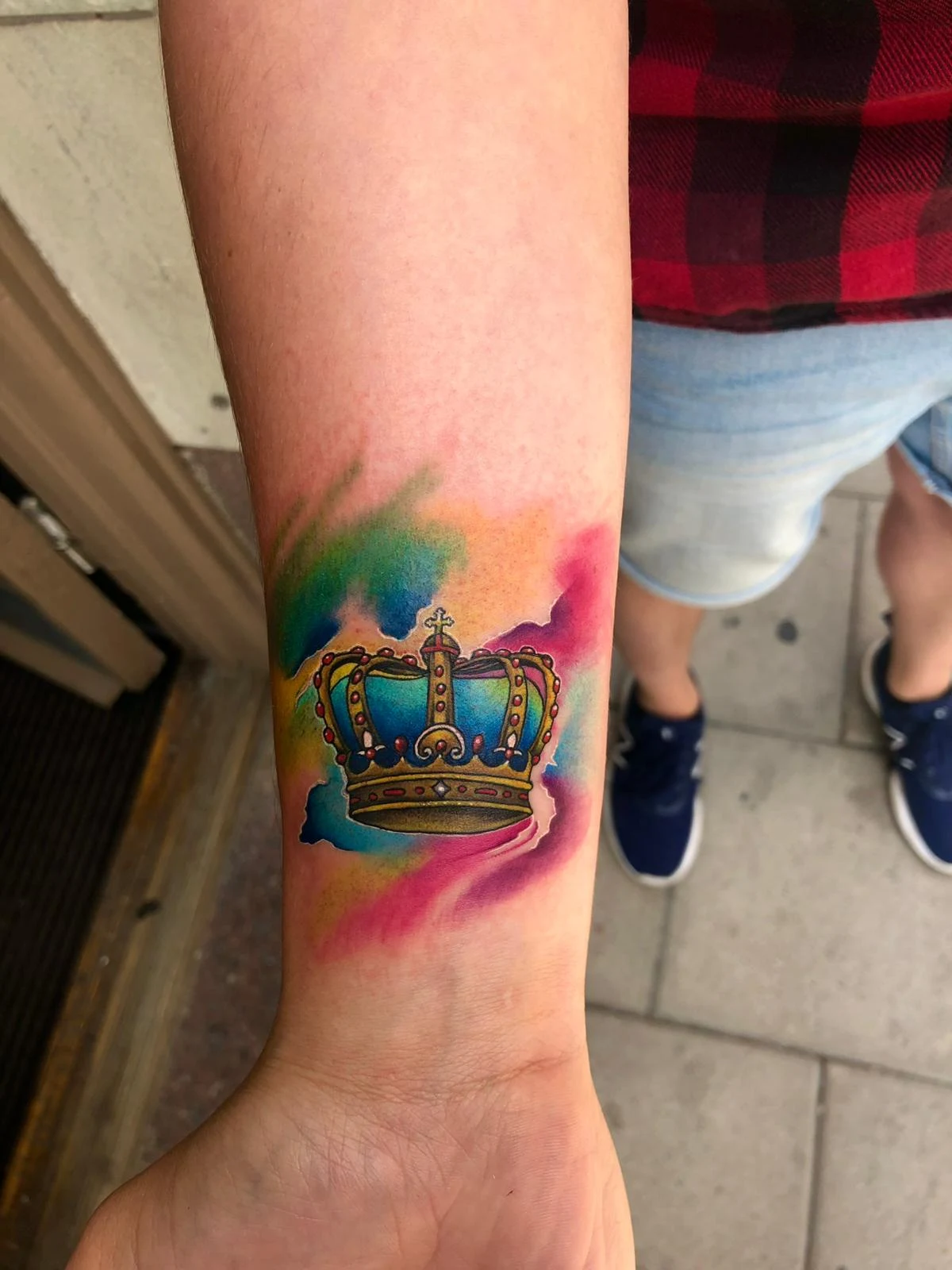
Neo-traditional means bold outlines, saturated colour, and graphic composition. This style shows up across ocean-themed work (seahorses, coral, tropical fish) and more Western-influenced imagery (traditional American motifs updated with Bali's tropical palette).
Colour work requires more aftercare in Bali's heat and humidity than black and grey. Medium custom colour pieces run USD $120–250.
Fine-line black work
Delicate single-needle or fine-line work for minimalist designs, scripts, botanical illustrations. This style is increasingly available but harder to find at the top level in Kuta than in Seminyak. Small fine-line pieces run USD $50–120.
Bali-inspired and Balinese tattoo designs
If you want something that genuinely connects to the island, these are the motifs with real roots in Balinese culture:
- Barong mask — the lion-like protective deity, a powerful subject for a chest or thigh piece. Bold, highly decorative, looks strong in both black and grey and colour.
- Garuda — the eagle-bird of Hindu mythology, national symbol of Indonesia. Works particularly well as a back piece or full chest. More significant symbolically than a generic eagle design.
- Balinese lotus — the padma, associated with purity and spiritual awakening. A common choice for smaller pieces (forearm, shoulder blade) and works well as a central element in geometric compositions.
- Sacred geometry — the Flower of Life and related patterns appear in Balinese temple architecture and translate directly into dotwork sleeves.
- Wave motifs — not uniquely Balinese, but the ocean is central to Kuta's identity. A wave done in a Japanese ukiyo-e style references both influences.
- Koi fish — Japanese in origin but popular across Bali's studios. Pairs well with lotus flowers and wave backgrounds.
None of these designs require any connection to Balinese Hinduism to wear. They're decorative and widely used by visitors. Still, it's worth knowing what you're choosing, because the artists here tend to give more care to pieces they find culturally meaningful.
Want a vetted, hygienic studio at a fair price — not a walk-in gamble? Andrew can match you with a trusted Kuta artist for your design.
Find me a studio 🤙Where to get tattooed in Kuta — area guide
The geography matters. Here's how the main areas break down:
Kuta Beach Walk strip
The Kuta Beach Walk strip is where the easiest studios to walk into are clustered. Walk-in capacity is generally good outside peak season (July–August).
It's convenient if you're staying anywhere in central Kuta or arriving from the airport (DPS is about 15 minutes south). Studios here cater heavily to walk-in tourism, so they're set up for quick turnaround on simpler pieces. You'll also find artists doing serious custom work if you look.
Poppies Lane I and II
Poppies Lane has cheaper studios, and some are good. But it also has more walk-in studios working on volume, low price, and less consistency on hygiene.
If you end up here, apply the hygiene checklist below more rigorously than anywhere else. The price will be lower, but the risk is higher.
Seminyak border (Legian and north)
The Legian strip running from Kuta north into Seminyak has some of the stronger specialist studios in the area. If you have a complex custom brief, such as a full sleeve, a large back piece, or a specific style you've researched, this is where to start.
Artists here tend to have more developed portfolios and take on fewer but more technically demanding commissions. Expect USD $80–120 per hour at the better studios.
What it costs in 2026
Prices at reputable studios in 2026:
Based on IDR market rates. Rates change — confirm with the studio. USD at ~IDR 16,000 / AUD at ~IDR 10,500.
Tiny design (under 5 cm): USD $30–95 / AUD $50–145
Small design (5–10 cm): USD $65–190 / AUD $100–290
Medium piece (10–20 cm): USD $190–440 / AUD $290–670
Large piece (20+ cm, single session): USD $440–940 / AUD $670–1,450
Half sleeve: USD $500–1,250 / AUD $770–1,900
Full sleeve or large back piece: USD $750–1,900+ / AUD $1,150–2,900+
You will find cheaper options, including USD $20–30 flash pieces on Poppies Lane. I don't refer guests to those.
The gap between a studio with proper sterilisation and a cheap walk-in shop is not just about quality of the design. It's about whether the needle was opened from sealed packaging in front of you, whether the autoclave is present and used, and whether the ink caps are fresh per session.
In a hot, humid tropical climate, these standards aren't optional. An infected tattoo in Bali is significantly harder to manage than at home, and it can cut your trip short.
Hygiene checklist before you sit down
Before the needle starts, you should see all of the following without having to ask:
- Health permit displayed — a physical licence on the studio wall. If it's not visible, ask to see it. If they can't produce one, leave.
- Needle opened from sealed packaging in front of you — not pre-laid-out, not unwrapped before you arrived.
- Fresh ink caps per session — small single-use cups for each colour, discarded after your piece.
- Surface disinfection visible — the bed or chair should be wiped with clinical disinfectant before you sit down.
- Gloves changed on contact — if the artist touches anything other than you and the machine, gloves should change.
A professional studio welcomes these questions. If your artist seems impatient or dismissive when you ask, that's your answer. Leave before the session starts, deposit or no deposit.
Ready to book? Tell Andrew your design and dates and he’ll line up a clean studio at the local price.
Book my tattoo 🤙How to book and what to bring
For custom work, book 24–48 hours in advance and bring your reference images. A clear visual reference, on screen or in print, makes a significant difference to the result.
Artists price by the image you actually show them, not the vague description in your head. Be specific about size and placement.
For flash or walk-in: arrive early. In peak season (July and August), the good studios fill walk-in slots by late morning. Outside peak season, afternoon is usually fine.
Bring:
- Reference images (saved offline in case of poor signal)
- Cash in IDR or USD — not all studios take cards, and those that do may add a fee
- Loose clothing that gives access to the placement area
- No alcohol in the last 24 hours (affects bleeding and healing)
I can line up a studio referral and get the price confirmed in Indonesian before you arrive. It takes one WhatsApp message and saves the negotiation on the day. Message me your design reference and your dates.
Andrew's take
I've been to these studios, and I've walked into plenty more that I wouldn't send anyone to. The tells are consistent: unlabelled ink bottles, a needle tray that doesn't look freshly laid out, an artist who quotes a price without looking at your reference image.
Kuta has enough genuinely capable studios that you don't need to settle for the first place that quotes you a low number.
The best advice I can give: decide your design and approximate size before you get to Bali, bring clear reference images, and spend thirty minutes checking the studio's recent work on Instagram before you walk in.
The artists worth booking are posting their work online. If a studio has no social presence and no portfolio to show you, that tells you something.
If you want me to match you to an artist based on the style you're after and confirm the appointment before you land, WhatsApp me the reference and your dates. It's a standard part of how I help guests plan their Kuta time.
Frequently Asked Questions
What are the most popular Balinese tattoo designs in Kuta?
The most requested work at Kuta studios covers: mandalas and sacred geometry dotwork, Balinese lotus flowers, Barong mask pieces, Garuda (the eagle deity of Balinese Hinduism), wave tattoos in Japanese ukiyo-e style, koi fish with floral backgrounds, and black and grey realism (eagles, tigers, wolves, portraits). Large-scale sleeve and back work is increasingly common as tourists plan their tattoo in advance rather than deciding on the spot.
How much does a tattoo cost in Kuta, Bali?
At reputable studios: small flash designs run USD $40–80, medium custom pieces USD $80–180, large forearm or calf pieces USD $180–400, and full sleeves or back pieces USD $400–800 or more across sessions. Specialist studios in the Seminyak area charge USD $80–120 per hour. Cheaper options exist on Poppies Lane, but the quality and hygiene standards vary significantly.
Is it safe to get a tattoo in Kuta, Bali?
At a reputable studio, yes. Check that the health permit is displayed, that the artist opens sealed needles in front of you, and that ink caps are single-use per session. Bali's tropical climate makes hygiene more critical than in cooler countries — an infected tattoo heals slowly in heat and humidity, and can cut your trip short. Use the checklist in this guide before sitting down.
Where is the best area for tattoos in Kuta?
The Kuta Beach Walk strip is where most of the walk-in studios are. Poppies Lane has cheaper options but requires more care in vetting hygiene. Studios just across the Seminyak border attract more specialist artists for complex custom briefs. If you're getting tattooed close to your airport arrival or departure, the Beach Walk area is most convenient to DPS.
Should I book a tattoo studio in Kuta in advance?
For custom work: book 24–48 hours ahead and bring reference images. For flash or simple walk-in pieces, outside of peak season (July–August) you can usually arrange same-day. In peak season, arrive early — popular studios fill walk-in slots by late morning. Having a referral and confirmed price before you arrive removes the negotiation pressure on the day.
Can I get a tattoo near Kuta airport?
Kuta is a 15-minute drive from Ngurah Rai International Airport (DPS), so studios in the Kuta Beach Walk area are the closest professional options to the airport. Plan your tattoo for the last couple of days of your trip, after your surf and swimming, but not the morning of your flight. Keep it out of the sea and pool for at least 2 weeks and follow your artist's aftercare instructions.