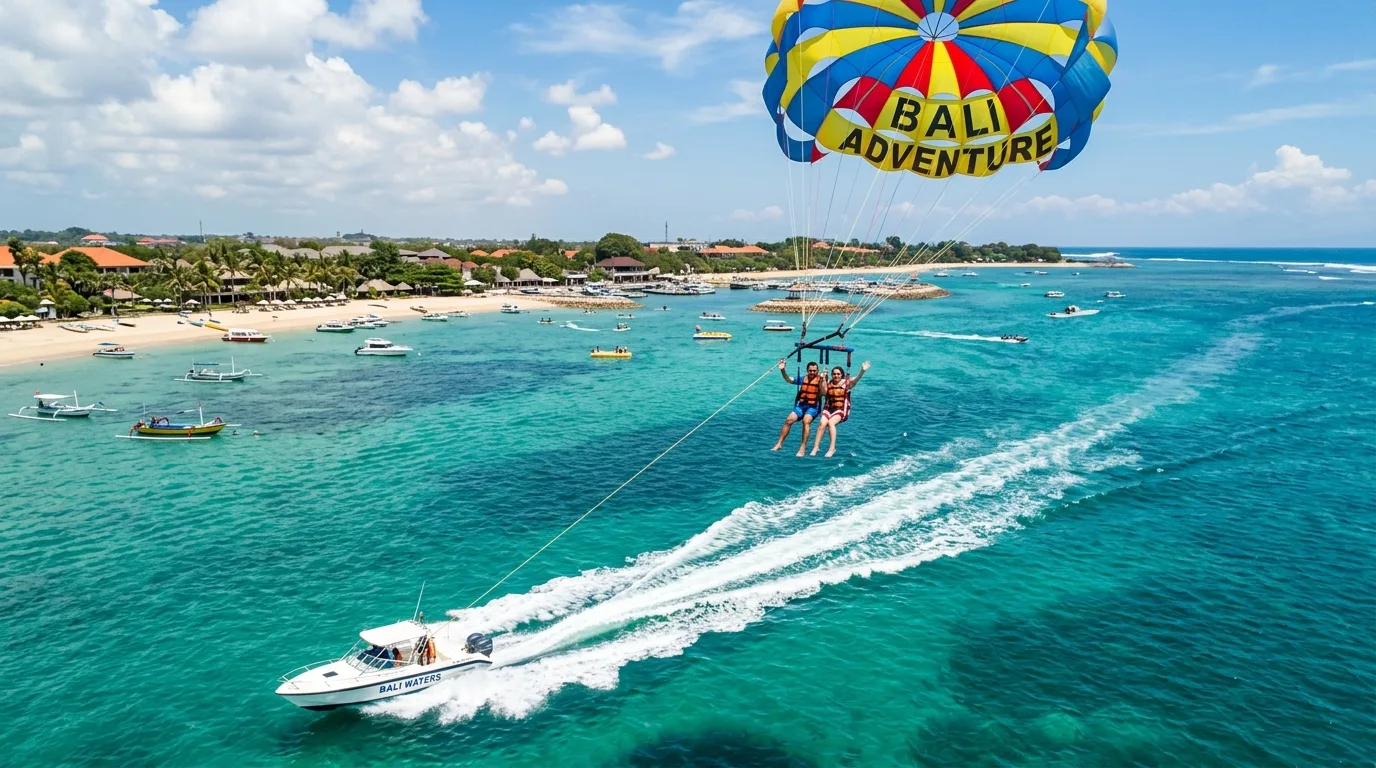
Almost every “water sports in Bali” photo you see is shot at Tanjung Benoa: parasailing over turquoise water, jet skis, the banana boat. It's a calm-water beach about 20–30 minutes south of Kuta. This is the one spot on the island set up for it, and the activities are genuinely fun.
The catch is the price. Tanjung Benoa is where first-timers get quoted double or triple what the activity actually costs.
So this guide gives you the real local ranges in USD, what each activity is like, and the few things I'd skip. It pairs well with a wider day of things to do in Kuta or a trip to Waterbom.
I'm a local guide based in Kuta and I arrange these for clients. The numbers below are what things really go for once you're not paying the walk-up tourist rate.
Where Bali's water sports actually are (and how to get there from Kuta)
There's a common idea that water sports are “on Kuta Beach.” They're not. Kuta's surf is too rough for jet skis and parasailing.
The real hub is Tanjung Benoa, a sheltered bay on the Nusa Dua side. The water there is flat and calm, which is exactly what you want for this stuff. From central Kuta it's a 20–30 minute drive depending on traffic.
You've got three sensible ways to get there. A Grab or Gojek car is cheapest if you're going on your own, and a metered Bluebird taxi is fine too.
If you want it simple, a driver who waits and brings you back is the least stressful. Tanjung Benoa is spread out, and you won't easily flag a ride home mid-afternoon.
- Activities run at Tanjung Benoa, not Kuta Beach — calm, flat water by design
- About 20–30 minutes from Kuta by car, traffic depending
- Grab / Gojek car is the cheapest one-way option
- A waiting driver is easiest if you want a half-day without hassle getting back
Don't want to gamble on Grab and getting a ride home? Andrew can set you up with a driver who waits and brings you back — just send your dates.
Sort my driver 🤙What you can actually do at Tanjung Benoa
The menu is the same across almost every operator on the beach. They all run the same activities. So you're really choosing on price and how the staff treat you, not on what's available.
Here's what's on offer and what each one is actually like.
- Parasailing — towed up behind a boat on a parachute; the classic Bali shot. A solo “round trip” is short (a few minutes up) but the view is the point.
- Jet ski — usually with a guide on the back or leading you; 15–20 minutes around a marked course.
- Banana boat / donut — inflatable towed behind a boat, 2–5 people, they'll tip you off if you ask (or even if you don't).
- Flying fish — a kite-shaped inflatable that lifts off the water; more of a thrill ride.
- Seawalker / Sea Walking — you walk on the seabed in a weighted helmet fed with air; no swimming needed, good for non-swimmers.
- Snorkelling & glass-bottom boat to Turtle Island — the calmer, family option; the boat trip usually gets bundled with a turtle conservation stop.
Real prices: what locals pay vs the tourist quote
This is the part that matters. The first price you're quoted on the sand at Tanjung Benoa is almost never the real price. It's a starting number aimed at people who don't know better.
Below are realistic ranges in USD once you've settled to a fair rate. Treat the low end as “good local price” and the high end as “still fine.”
If you're being quoted well above this, walk to the next operator. There are dozens and they all watch each other.
Prices move with the season, fuel, and how busy the day is. Use these as a sense-check rather than a fixed menu.
- Parasailing (solo round): about USD $15–25 — tourists are often quoted $35–45
- Jet ski (15–20 min): about USD $20–35
- Banana boat / donut (per person): about USD $10–15, usually min 2 people
- Flying fish: about USD $20–30
- Seawalker / Sea Walking: about USD $40–55
- Snorkelling or glass-bottom + Turtle Island: about USD $15–30 depending on time on the water
Rather not haggle on the sand? Tell Andrew which activities you want and he'll line up the local price — you pay what locals pay, not the tourist quote.
Get the local price 🤙How the combo packages work (and which are worth it)
Every operator pushes a “package”: three or four activities bundled for one price. These can genuinely save money if you were going to do all of those activities anyway. The trap is being talked into a five-activity combo when you really only wanted to parasail.
A combo that includes parasailing + banana boat + jet ski is the most common. A fair bundled price usually undercuts paying for the three separately.
My rule: decide what you actually want before you arrive, get the per-activity prices first, then only take the package if the maths beats doing them à la carte.
- Packages save money only on activities you'd have done anyway
- Get individual prices first, then compare against the bundle
- Don't let a 5-in-1 combo talk you into rides you don't want
- Ask exactly what's included — boat, gear, photos, and how many minutes/rounds
Safety and what to check before you hand over money
Tanjung Benoa is well run on the whole. But standards do vary operator to operator, and you're the one in the water, so a few checks are worth it. The water is calm, which removes most of the risk. Gear and briefing quality is where the difference shows.
For anything towed (banana boat, flying fish) you'll be wearing a life jacket. Make sure it actually fastens and fits, especially for kids.
For Seawalker, a basic health check matters. It's generally fine for non-swimmers and people who don't dive. But skip it if you have serious ear, heart or breathing problems, and tell the staff if you're unsure.
- Life jacket should fit and clip properly — check it yourself, don't assume
- Listen to the safety briefing; if there isn't one, that tells you something
- Seawalker is fine for most non-swimmers but not if you have ear/heart/breathing issues
- Kids: confirm minimum ages and that there's a child-sized jacket
- Don't do water sports straight after a big meal or any alcohol
Best time to go, and booking vs paying on the beach
Morning is better for almost everything here. The water is calmest and the light is good for photos. You also beat both the heat and the bus groups that roll in mid-morning. Aim to arrive by 9–10am if you can.
You don't have to pre-book to get a fair price. Turning up and negotiating works because competition is fierce.
Pre-booking online is mostly about convenience and skipping the haggle. It can be worth it if you'd rather not bargain on holiday. Either way, agree the exact price, what's included and the number of rounds before you get in the boat, not after.
- Go in the morning — calmest water, best light, fewer crowds
- Dry season (April–October) is the most reliable for clear, flat water
- You can get a fair price walking up; pre-booking just saves the haggle
- Lock in price + inclusions + number of rounds before you start
How I keep it simple for clients (and what I'd skip)
I'm based in Kuta and deal with the Tanjung Benoa operators regularly. So the easiest version for most people is to tell me what you want to try. I'll line up a fair price and a driver, so you're not negotiating in the sun or worrying about the ride home. There's no tourist markup in that. You pay the local rate and I handle the back-and-forth.
What would I skip? If you're short on time, the five-activity mega-combos are usually more than you need. Two or three is plenty for a fun half-day.
And if you mainly want calm, photogenic time on the water with kids or non-swimmers, the glass-bottom boat to Turtle Island plus a parasail beats spending big on the high-adrenaline rides.
- Tell me what you want; I arrange a fair price + driver, no markup
- Two or three activities is a great half-day — you don't need all five
- Families / non-swimmers: glass-bottom + Turtle Island + a parasail is the sweet spot
- Always confirm the local price before you commit
Frequently Asked Questions
How much do water sports cost in Bali?
As a rough guide in USD once you're at a fair local rate: parasailing about $15–25, jet ski about $20–35, banana boat about $10–15 per person, flying fish about $20–30, and Seawalker about $40–55. The first price quoted on the beach is usually higher, so it's worth comparing a couple of operators or having someone local sort the price.
Where are the water sports near Kuta?
They run at Tanjung Benoa, a calm-water beach about 20–30 minutes south of Kuta near Nusa Dua — not on Kuta Beach itself, which is too rough. A Grab car or a waiting driver from Kuta both work.
Is it safe for non-swimmers and kids?
Yes for most activities. The bay is calm and you wear a life jacket for anything towed. Seawalker is designed for non-swimmers since you walk on the seabed with air fed to a helmet. Just check the jacket fits, confirm minimum ages for children, and skip Seawalker if you have ear, heart or breathing problems.
Can I do Seawalker if I can't swim?
Yes — that's the point of it. You walk on the seabed in a weighted helmet with air piped in, so you keep your head dry and don't need to swim or dive. Tell the staff about any ear, sinus, heart or breathing issues first, as those are the main reasons to skip it.
Should I book in advance or just pay on the beach?
Both work. Competition at Tanjung Benoa is intense, so you can usually walk up and negotiate a fair price. Pre-booking online mainly saves you the haggling and locks in what's included. Whatever you choose, agree the price, inclusions and number of rounds before you get in the boat.
What's the best way to avoid overpaying?
Decide what you want before you arrive, ask for per-activity prices first, and don't get upsold into a five-activity combo you didn't want. If a quote is well above the ranges here, walk to the next operator — there are dozens. Or have a local arrange it so you pay the real rate from the start.