Once a year, the busiest island in Indonesia goes completely silent. No traffic, no shops, no flights, no lights. Just Bali, quiet, for a full day.
That's Nyepi, the Balinese Day of Silence. The night before it, though, is the opposite: the streets fill with giant demon effigies, drums and crowds. I spend it here in Kuta every year, so here's what actually happens, where to watch the Ogoh-Ogoh, and how to handle the silent day if you're visiting.
What Is Nyepi? Bali's Day of Silence Explained
Nyepi is the Balinese Hindu New Year, the turn of the Saka calendar. Where most of the world sees in a new year with fireworks and noise, Bali does the opposite: it welcomes it with total silence.
For 24 hours the island observes four restraints, the Catur Brata Penyepian: no fire or light, no work, no travel or going out, and no entertainment. The idea is that if the island looks dark, empty and silent, any lingering evil spirits will assume it's abandoned and move on.
It's not a show put on for tourists. It's a real religious observance, and for that one day everyone on the island takes part, visitors included.
Melasti: The Purification Before Nyepi
The Ogoh-Ogoh night isn't where it all starts. A few days before Nyepi comes Melasti, the purification — and it's the part most visitors never hear about.
Nyepi isn't really one day; it's a short sequence, and Melasti opens it. It usually falls three to four days before the silent day. In 2026 that put Melasti on 16 March, with Nyepi following on the 19th.
The heart of it is water. In Balinese Hindu belief the sea holds holy, life-giving water, and Melasti uses it to wash the past year off the community before the new one begins — the body and the mind, but above all the temple.
What actually happens at Melasti
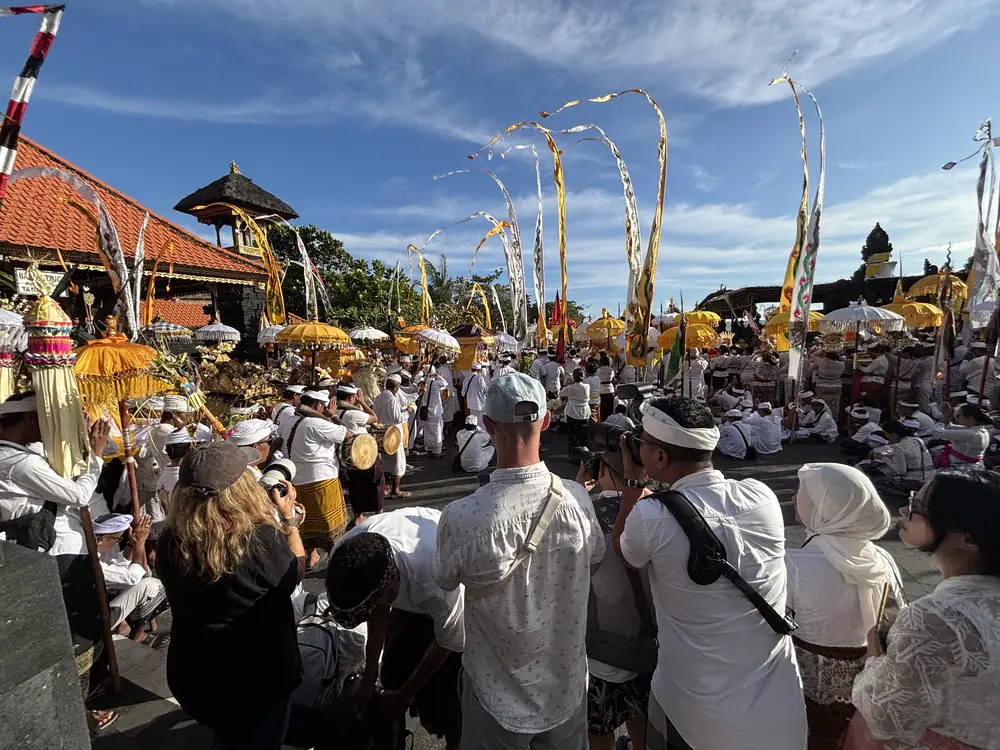
Each banjar (the neighbourhood ward) runs its own procession, and the whole village takes part. People dress in white and yellow, the colours of purity, and walk down to the water together.
They don't go empty-handed. Along with offerings of fruit, flowers and rice, they carry the temple's sacred objects down to the sea: the arca (statues), pratima and pralingga — the ritual effigies and implements believed to hold the temple's divine presence. Cleansing these is the real point. A village that starts the year purified is a village that's looked after.
At the shore a priest leads the prayers and chants, worshippers bathe, and holy water is gathered and carried back to the temple to be used through the rest of Nyepi week.
Where to see Melasti
Because the processions head for the coast, beaches and sea temples are where it happens. Sanur, Kuta, Seminyak and Nusa Dua all see them, and the sea temple of Tanah Lot is one of the best-known spots of all. The whole island does it at once, which is part of why it feels so big.
So the full rhythm runs in order: Melasti a few days out, the Ogoh-Ogoh parade on the eve, then the silent day itself. If your trip lines up, a Melasti procession — all white cloth, ceremonial umbrellas and tall umbul-umbul banners against the blue — is one of the most striking things you'll see in Bali.
Ogoh-Ogoh Parade: What Happens the Night Before Nyepi
The evening before Nyepi is called Pengerupukan, and it's the loud, spectacular half of the festival. This is when each neighbourhood brings out its Ogoh-Ogoh.
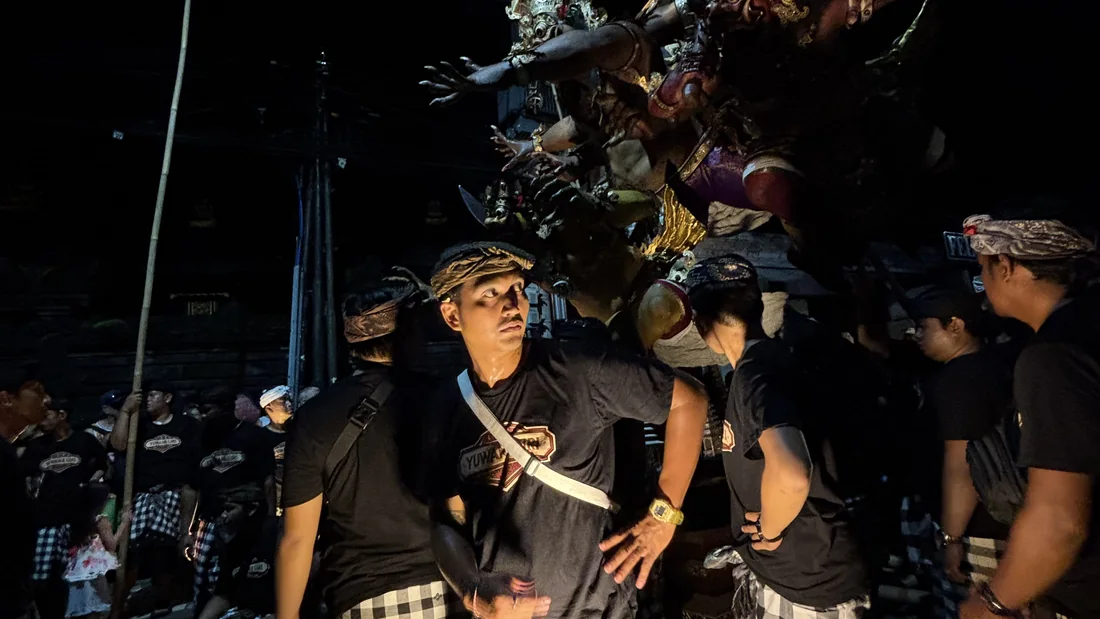
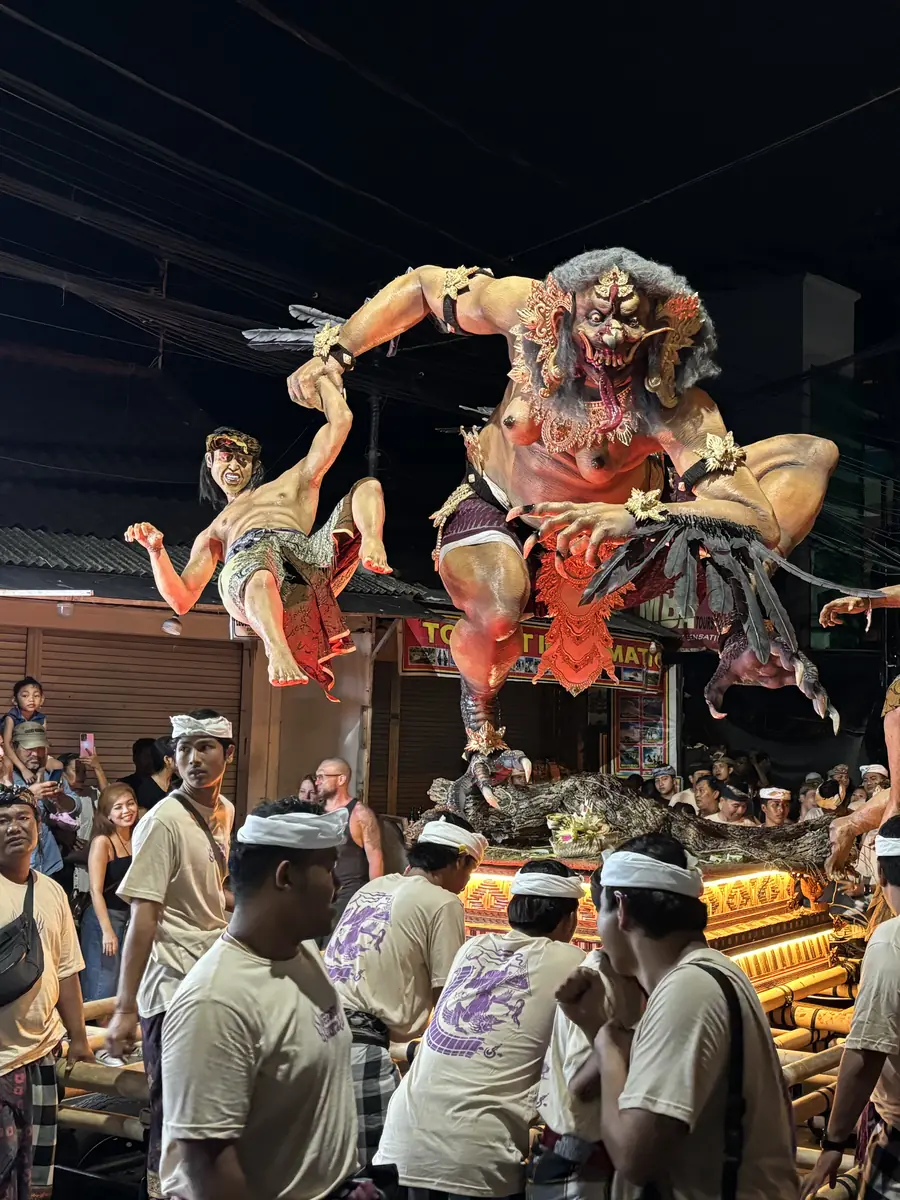
An Ogoh-Ogoh is a giant demon effigy, built over weeks from bamboo, paper, foam and cloth. They represent negative forces and bad spirits, and the young men of each banjar (neighbourhood ward) spend months making them. Some stand several metres tall, with fangs, claws and wild painted faces.
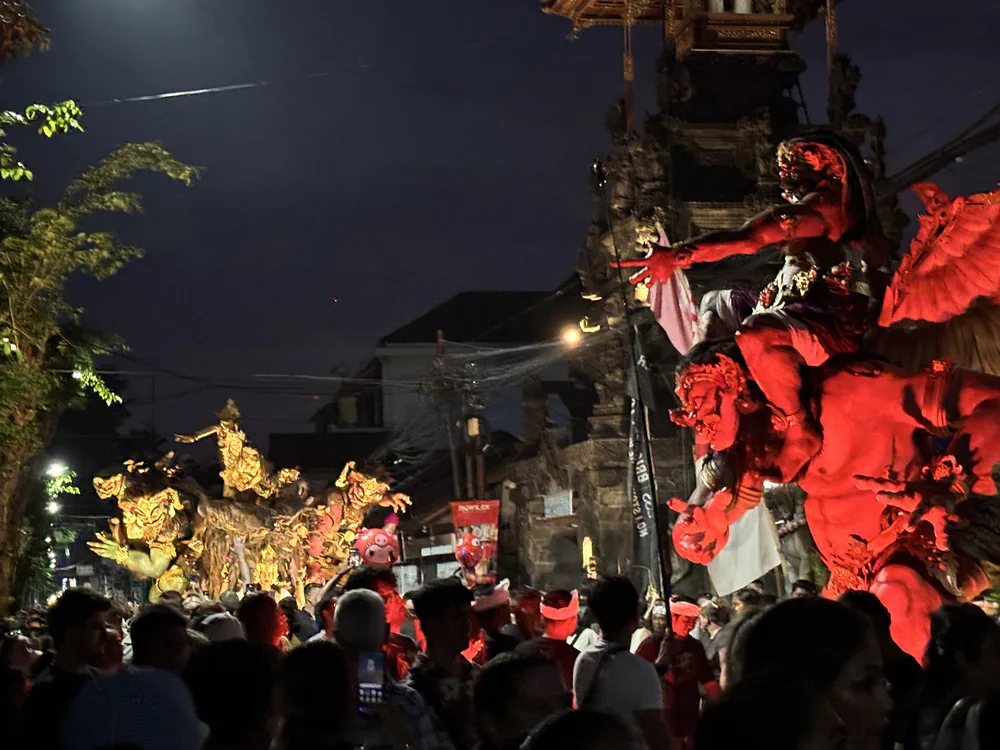
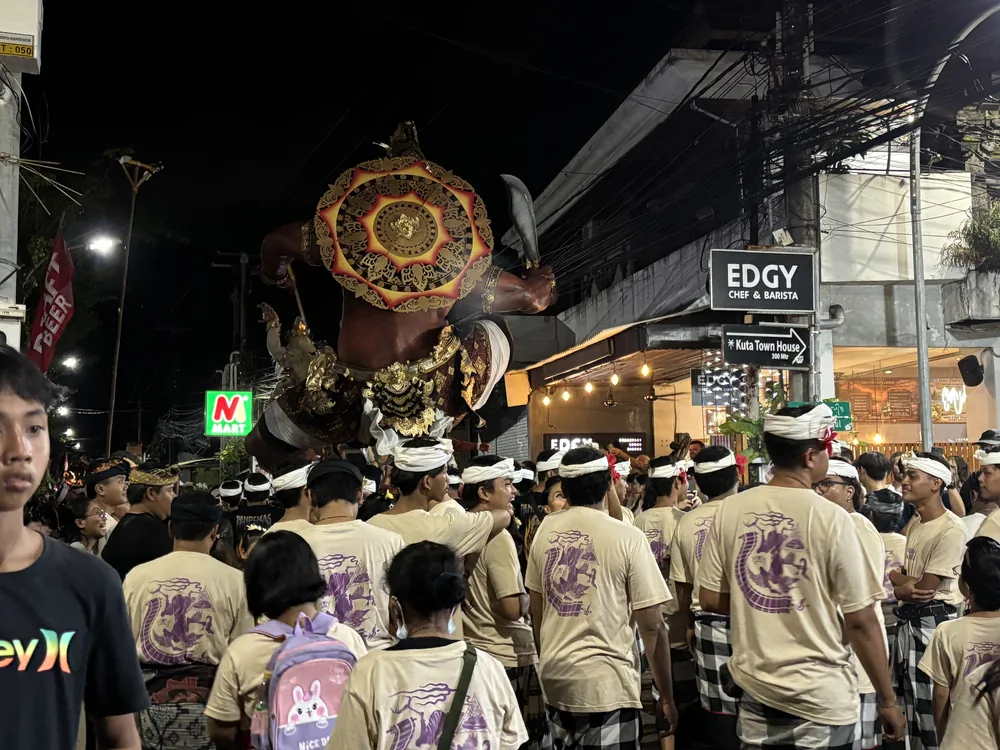
After dark, teams hoist the effigies onto bamboo platforms and carry them through the streets, spinning and shaking them at crossroads, with drums (baleganjur) hammering and crowds following. Traditionally the Ogoh-Ogoh are burned afterwards, carrying the bad spirits away with them so the island is clean for the silence.
Where to Watch the Ogoh-Ogoh Parade in Kuta
You don't need a ticket or a tour — the parade happens on the public streets and it's free. If you're staying in Kuta, here's where to be:
- Jalan Legian: the main strip through Kuta and Legian, and the busiest spot. The most effigies pass through here and the crowd is biggest. This is where I'd start.
- Jalan Pantai Kuta (the beach road): the road running along Kuta Beach also sees parades and is a little more open than the tight middle of Legian.
- The main Kuta crossroads: the junction where Jalan Legian meets Jalan Pantai Kuta, near Bemo Corner, is a natural gathering point where the effigies are spun and shown off.
- Your own neighbourhood streets: every banjar parades its own Ogoh-Ogoh, so wherever you're staying there'll likely be one nearby before it heads to the main road.
Get into position in the early evening — parades usually build after sunset, from around 6–7 PM. Bring water, expect crowds, and keep an eye on your belongings the way you would in any busy street event.
Nyepi Rules in Bali: What You Can and Can't Do
The morning after the parade, everything stops. Nyepi runs a full 24 hours, from 6 AM to 6 AM the next day, and the four restraints are taken seriously.
- No going outside. The streets are empty. Nobody drives, walks or works — locals and visitors both stay in. The traditional village security, the pecalang, patrol to keep it that way.
- No lights at night. After dark you keep lights low and curtains drawn so no glow shows outside. It's why the stars over Bali on Nyepi night are unreal.
- No noise. Keep it quiet — no loud music, no parties.
- The airport is closed. Ngurah Rai shuts completely for the 24 hours — no flights in or out. In recent years even mobile data has been limited across the island.
Hotels keep running quietly for guests, with staff on site and food available, so you're looked after inside — you just stay within the grounds.
Coming around Nyepi and want your days planned so the silent day doesn't catch you out — flights, hotel, and what to do either side? Message me and I'll sort it.
Plan around Nyepi 🤙Nyepi for Tourists: Hotels, Beaches, Airports & Going Outside
Nyepi catches visitors out more than locals, so here are the questions I get asked most — and one bit of advice up front: stock up on snacks and water the day before, because everything outside your hotel is shut.
Can tourists leave their hotel during Nyepi?
No. For the full 24 hours, you stay within your hotel or villa grounds — the same rule applies to locals and visitors. The streets are empty and the traditional pecalang security patrol to keep it that way. Inside the grounds you're free to use the pool, eat and relax; you just don't go out onto the street.
Are Bali beaches closed during Nyepi?
Yes, in effect. The beach counts as "outside", so you can't go down to Kuta Beach or any other beach during Nyepi. It's one of the few days of the year the sand is completely empty.
Is Bali airport closed on Nyepi?
Yes. Ngurah Rai (Denpasar) shuts completely for the 24 hours — no flights land or take off. A flight scheduled on Nyepi simply won't run, so check the date before you book and don't fly on the day itself.
Do hotels operate during Nyepi?
Yes, quietly. Staff stay on and food is available, and pools and restaurants run in a low-key way inside the grounds. After dark you keep lights and noise down so nothing shows outside. Picking a hotel with a pool and some space makes the day feel easy rather than long.
Is the internet available during Nyepi?
Sometimes not. In recent years mobile data has been switched off across the island for the day as part of the observance; hotel wifi has generally stayed on, but don't count on it. The easiest approach is to treat Nyepi as a proper digital detox.
How to Experience Nyepi and Ogoh-Ogoh in Bali
If you want the full experience — the spectacle and the silence — a few things help:
- Arrive a day or two before Nyepi eve. That way you catch the Ogoh-Ogoh parade and are settled in before the island shuts.
- Watch the parade in the early evening, then head in. The big effigies come out after dark; you don't need to stay till the very end.
- Look up on Nyepi night. With the whole island dark, the star field is one of the best you'll ever see over Bali.
- Respect it. This is a sacred day, not a novelty. Keeping quiet and staying in isn't a rule to dodge — it's the whole point.
If you're building a longer trip around it, Nyepi pairs well with slower inland days — see my things to do in Kuta guide for the days either side, or the Bali trip planner to map it all out.
Is Nyepi Worth Experiencing in Bali? Andrew's Take
Yes — it's one of the most special times to be here, as long as you know what you're walking into. The Ogoh-Ogoh night is genuinely one of the best things you'll see in Bali, and the silent day is unlike anything else.
The people who have a bad Nyepi are the ones who didn't know it was coming — stuck with a cancelled flight or a locked hotel and nothing to eat. The people who planned for it get a front-row seat to the parade and then a rare, quiet day on an island that's never quiet.
Know the date, don't fly that day, stock up, and enjoy it. It's the one day Bali truly stops.
Nyepi Bali FAQ
When is Nyepi in Bali?
Nyepi is the Balinese Saka New Year and the date moves each year with the lunar calendar, usually landing in March. In 2026 it fell on 19 March, with the Ogoh-Ogoh parade the evening before, on 18 March. The next Nyepi is Monday 8 March 2027, with the Ogoh-Ogoh parade the evening before, on 7 March.
Where can you watch the Ogoh-Ogoh parade in Kuta?
In Kuta the parade runs along the main streets. Jalan Legian is the busiest, with the most effigies and the biggest crowds; Jalan Pantai Kuta (the beach road) and the main Kuta crossroads also fill up. Each neighbourhood builds its own Ogoh-Ogoh, so side streets have them too, but the town-centre streets are where they gather. Get there in the early evening.
Can tourists go out during Nyepi?
No. For the 24 hours of Nyepi, nobody goes outside — locals and tourists alike. You stay within your hotel or villa grounds, keep lights and noise down after dark, and the traditional pecalang security patrol the streets. The airport is closed too, so no flights land or leave.
Does the airport close for Nyepi?
Yes. Ngurah Rai (Denpasar) airport shuts completely for the full 24 hours of Nyepi — no arrivals or departures. If your flight lands on or leaves during Nyepi, you'll need to change it, so check the date before you book.
Is Nyepi a good or bad time to visit Bali?
It's a special time if you plan for it. You get the spectacle of the Ogoh-Ogoh parade the night before, then a genuinely quiet day, dark skies full of stars, and the island at its calmest. The catch is you're confined to your hotel for 24 hours, so bring snacks and something to do, and don't schedule flights on the day.