Ubud gets sold as rice terraces and yoga, but the thing most of my guests remember is the water. East of town the land drops into river gorges, and almost every one of them hides a waterfall you can reach in under an hour. Some are famous and busy. Others you'll have close to yourself if you turn up early.
I'm Andrew, an Indonesian local guide based in Kuta, and I've driven guests out to these falls more times than I can count. This is my honest guide to the best Ubud waterfalls: eight that are worth the drive, how to reach them, what they cost, which ones you can swim in, and how to string a few together in one day without spending it all in the car.
Planning a waterfall day around Ubud
First, the geography. Most of these waterfalls sit east and north-east of Ubud in Gianyar regency, 25 to 45 minutes away by car. Goa Raja and Tukad Cepung are the outliers, further out in Bangli and closer to an hour, but they're only a few minutes from each other. That matters, because the fun part is the falls and the boring part is the road.
Entry is cheap everywhere. Expect to pay USD $1–4 per person at the ticket hut, plus a small parking fee. Bring cash in small notes. Nobody takes cards out here.
Timing changes your whole day. Arrive between 8 and 10 in the morning and you get soft light, clear water and room to swim. Arrive after 11 and you share the pool with the tour buses. Dry season, April to October, is when the water runs clear and green. In the wet months the same falls turn brown and pushy, and a few close when the flow is too strong.
If you're coming up from Kuta or Seminyak, a driver for the day is the easiest way to link several falls. My guide to private driver prices in Bali covers what a full day should cost at the local rate.
For the stop afterwards, the TIS Cafe menu and prices page lays out what a rice-terrace lunch above Tegallalang runs to.
💡 Tips
- Most falls: 25–45 minutes east of Ubud; Goa Raja and Tukad Cepung closer to an hour
- Entry USD $1–4 per person, small parking fee, cash only
- Best window: 8–10am, dry season (April to October)
- Wear sandals with grip, pack a dry bag and a change of clothes
1. Kanto Lampo Waterfall
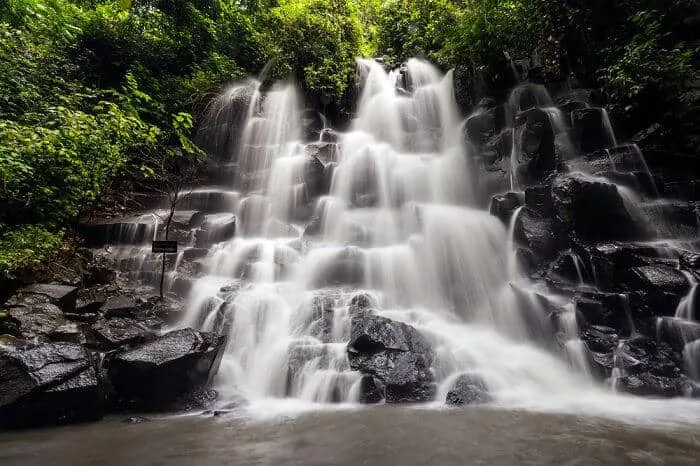
Kanto Lampo doesn't look like the others. Instead of one drop, the water fans out over a stepped wall of black rock, so it spreads into dozens of thin white streams. It's the most photographed fall in the area for exactly that reason.
The walk from the car park is short, under ten minutes, but the last section is a wade through the stream. Water shoes or sandals with grip make a real difference here, because the rocks are polished smooth.
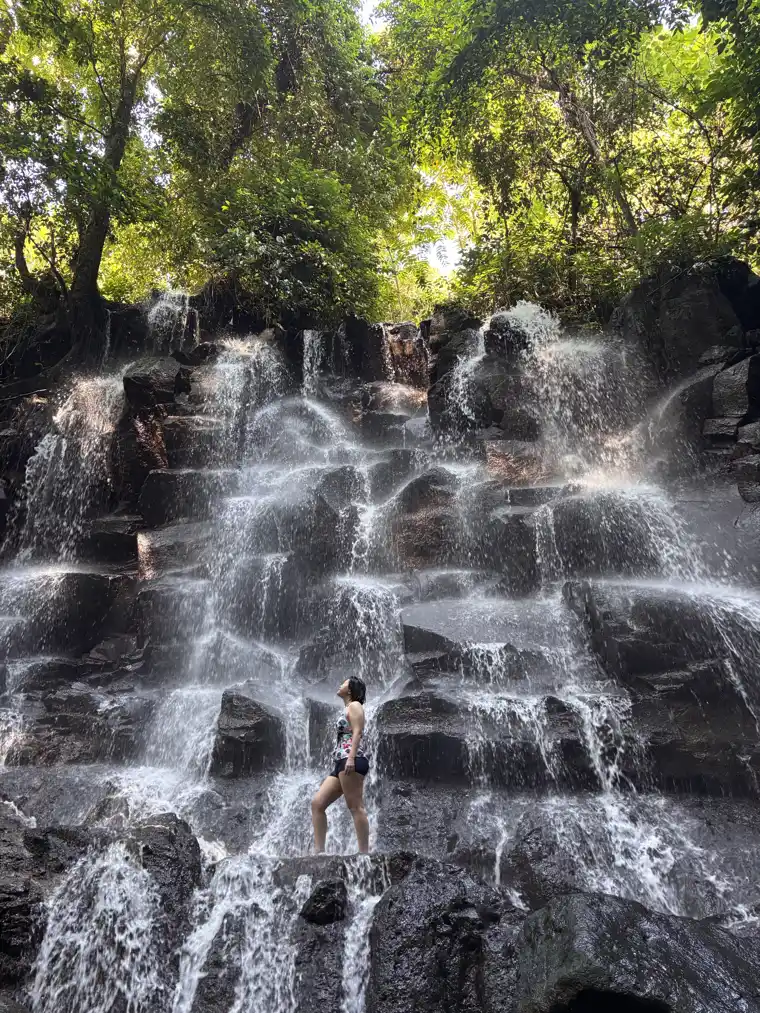
To get the classic shot you climb onto the rocks under the flow itself. There's nobody stationed here to help, so it comes down to whoever brought you. When I take guests in, I show them which rock is safe to stand on and how to pose so the water frames the shot, and I take the photo. Expect a queue after 10am. It's near Beng in Gianyar, close to both Goa Rang Reng and Tegenungan, which makes it an easy link in a three-fall morning.
💡 Tips
- Water spreads over a black stepped rock face
- Short walk, then a wade through the stream: grippy footwear
- No staff on site: your guide shows you where to stand and how to pose (I do this for my guests)
- Queue for the photo spot builds after 10am
- Close to Goa Rang Reng and Tegenungan for a combined trip
- Open in Google Maps →
2. Tibumana Waterfall
Tibumana is my usual answer when someone asks which waterfall to pick for swimming. A single ribbon of water drops into a round pool ringed by moss and ferns, and the whole place feels closed in and calm.
The walk in is the gentlest of the seven. It's around 15 minutes on a flat path with small bridges, so there's no scramble and almost no steps. That makes it a good choice for families and anyone who isn't keen on slippery climbs.
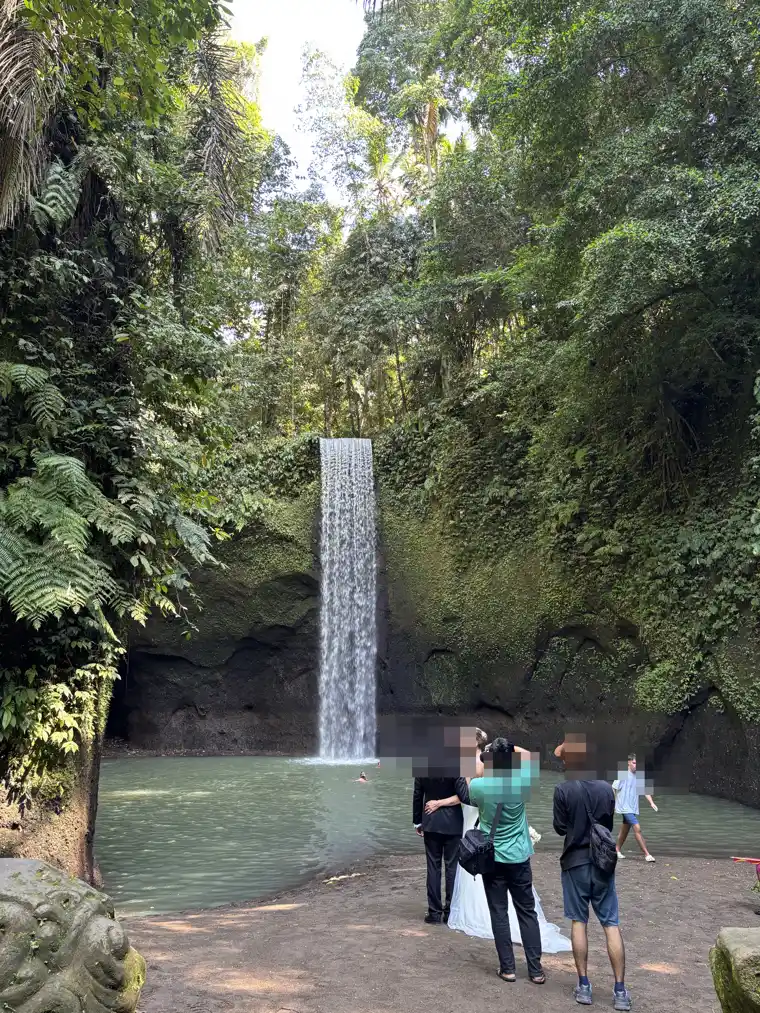
The pool is deep enough to swim properly. Bring a dry bag for your phone, because the spray reaches the edges. Tibumana sits about 30 minutes east of Ubud, and it pairs naturally with Suwat, which is only a short drive away.
💡 Tips
- Easiest walk in: flat path, about 15 minutes
- Round pool, deep enough for a real swim
- Best pick for families and nervous walkers
- Pairs with Suwat on the same road
- Open in Google Maps →
3. Goa Raja Waterfall
Goa Raja means the king's cave, and that's the shape of the place: a tall, thin waterfall dropping into a mossy canyon in Jehem village, Bangli, with a big cave at the back and a pool at the bottom. It's about 45 minutes from Ubud and only a few minutes from Tukad Cepung, so the two belong on the same trip.
The walk in is around 15 minutes. It starts steep downhill for the first few minutes, then levels out along the stream. You cross the water once on slippery rocks, and a couple of the bamboo bridges are in rough shape, so take it slowly and wear something with grip.
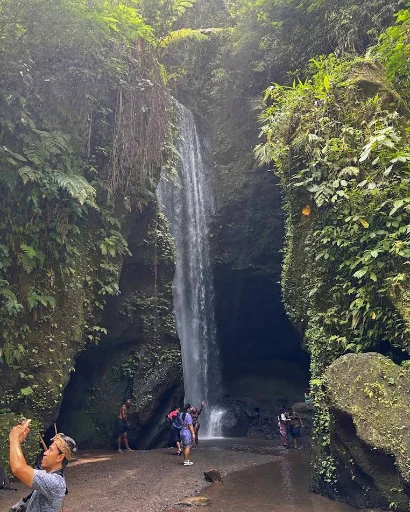
At the bottom there's a built pool with a stone rim that the water spills over, and a bamboo shack to change in. You can swim. There's a small shrine beside the pool, so treat it as a place people also come to pray, not just a swimming hole.
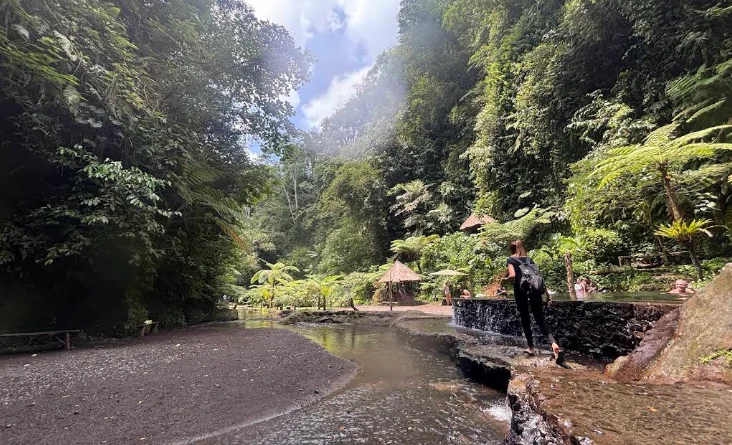
One honest warning: in the driest months the stream above can be diverted to water the rice fields, and the fall shrinks to a trickle or stops. Late wet season and the months just after it are when it runs properly. Even on a busy day you'll usually share it with a handful of people, which is the opposite of Tegenungan.
💡 Tips
- Cave, tall thin fall and a swimmable pool with a stone rim
- 15-minute walk: steep start, one stream crossing, worn bamboo bridges
- Can run dry in the driest months when water is diverted to rice fields
- Very few visitors; a few minutes from Tukad Cepung
- Open in Google Maps →
4. Tegenungan Waterfall
Tegenungan is the one everybody has heard of, and for good reason. It's the closest of the big falls to south Bali, sitting at Kemenuh between Ubud and Sukawati, so it's an easy first stop on the way up from Kuta. The waterfall itself is wide and heavy, a proper curtain of water crashing into a big pool.
Getting down means a lot of stairs. They're solid concrete, so it's fine for kids and grandparents who take it slowly, but the climb back up in the heat is the part people forget about. There are cafes and photo platforms at the top if you want to catch your breath with a view.
You can swim in the pool in dry season. The lifeguards will whistle you back if the current picks up. Because it's so easy to reach, it's also the busiest fall on this list. Go at opening time or accept the crowd.
💡 Tips
- Closest big waterfall to Kuta and Seminyak
- Lots of concrete steps down, and back up in the heat
- Swimming allowed in dry season, lifeguards on site
- Busiest of the seven: arrive early or go late afternoon
- Open in Google Maps →
5. Suwat Waterfall
Suwat is the quiet one. It's in the same part of Gianyar as Tibumana but gets a fraction of the visitors, mostly because it's less photographed. A tall single drop lands in a wide green pool with plenty of room to float around.
The path down is short with some steps, and the pool edge is shallow enough to wade in gradually. On a weekday morning you may have it to yourself for a while, which is rare anywhere near Ubud these days.
There isn't much here beyond the waterfall and a warung selling drinks, and that's the appeal. If Tegenungan is the busy postcard, Suwat is the one you go to when you want to hear the water instead of other people's speakers.
💡 Tips
- Few visitors, especially on weekday mornings
- Tall single drop into a wide swimming pool
- Short walk with steps; wade in from the shallow side
- Minimal facilities: bring your own water and snacks
- Open in Google Maps →
6. Goa Rang Reng Waterfall
Goa Rang Reng is less a waterfall you look at and more one you walk on. The water slides down a long sloping rock face rather than dropping off a cliff, so you can climb up beside it and sit in the shallow flow.
The descent is the nicest of all seven. Carved stone steps wind down past small Hindu shrines, and local people still come here for cleansing rituals, so keep your voice down and step around any offerings. There's a small cave at the base that gives the place its name.
It's about 30 minutes east of Ubud, sees a fraction of Tegenungan's crowd, and pairs naturally with Kanto Lampo just up the road.
💡 Tips
- Slide-style cascade you can sit in, not a sheer drop
- Carved steps with shrines: a sacred site, so be respectful
- Quiet even in high season
- Combine with Kanto Lampo, about 10 minutes away
- Open in Google Maps →
7. Sumampan Waterfall
Sumampan is Tegenungan's overlooked neighbour, about 25 minutes from central Ubud and a few minutes from the big fall. What makes it different is the rock art. An artist named Nyoman Retana carved faces and figures into the cliff beside the water, and they're worth the trip on their own.
The trail is rougher than the others. The steps are still a bit overgrown, they get slippery after rain, and there's a river crossing with a rope to hold. It's not hard, but it's not the one for flip-flops or small kids.
The pool at the bottom is small and not very deep, so think of it as a place to cool your feet and look at the carvings rather than a swimming spot. Because it's so close to Tegenungan, you can do both before lunch.
💡 Tips
- Cliff carvings by Nyoman Retana beside the fall
- Rougher trail: overgrown steps and a rope river crossing
- Shallow pool, better for wading than swimming
- Minutes from Tegenungan, easy to combine
- Open in Google Maps →
8. Tukad Cepung Waterfall
Tukad Cepung is the one I save for last on a tour because it's the biggest reveal. It hides inside a canyon in Bangli, and you only see it once you've walked up a shallow stream between high rock walls. Then the gorge opens and the water drops straight down through a gap in the ceiling.
On a clear dry-season morning, sunlight comes through that gap in visible beams. That's the photo everyone comes for. The light usually lands mid to late morning, so this is one fall where turning up at opening doesn't help. Aim for around 9 to 11.
The walk is easy, around 15 minutes each way, with a section through ankle-deep water. It's a good hour from Ubud, so it makes more sense paired with Goa Raja and a Kintamani day than as a quick hop. If you're already heading up for a Mount Batur sunrise, stopping here on the way back works well.
💡 Tips
- Enclosed canyon waterfall with light beams on clear mornings
- Best light 9–11am in dry season
- Easy 15-minute walk through a shallow stream
- Furthest out: pair with Goa Raja and a Batur or Kintamani day
- Open in Google Maps →
Which waterfall should you pick?
If you only have one morning, pick by what you want out of it. For a first-timer who wants the classic big fall and easy access, Tegenungan. For a proper swim, Tibumana or Suwat. For photos, Kanto Lampo and Tukad Cepung. For quiet and a bit of culture, Goa Rang Reng. For a cave and almost nobody else around, Goa Raja.
For a full day, the Gianyar cluster is the smart route: Tegenungan and Sumampan first, then Kanto Lampo and Goa Rang Reng, all within a short drive of each other. Add Tibumana and Suwat if you're moving fast. Goa Raja and Tukad Cepung belong together on a separate Bangli day, with the volcano if you have the time.
The mistakes I see most often are simple ones. Arriving at midday and finding a queue. Wearing flip-flops onto wet rock. Turning up in wet season expecting green water. And trying to do the whole list in one day, which mostly means seeing seven car parks.
Andrew's take: my favourite combination for guests is Goa Rang Reng, Kanto Lampo and Tibumana, in that order, starting early. Three very different waterfalls, one easy loop, back in Ubud for a late lunch. If you'd rather mix waterfalls with a holy spring and the rice terraces, my Sebatu holy spring day trip and the Ubud day trip from Kuta cover those routes.
💡 Tips
- Easy classic: Tegenungan
- Best swim: Tibumana or Suwat
- Best photos: Kanto Lampo and Tukad Cepung
- Quietest: Goa Raja, Goa Rang Reng and Suwat
- Gianyar loop: Tegenungan, Sumampan, Kanto Lampo, Goa Rang Reng
- Bangli pair: Goa Raja and Tukad Cepung
Frequently Asked Questions
Do Ubud waterfalls charge an entrance fee?
Yes, but it's small. Most charge roughly USD $1–4 per person at a ticket hut near the car park, plus a small parking fee. Bring cash in small notes; there are no card machines out here.
How many waterfalls can you visit in one day?
Three is comfortable, four if you start early and keep moving. Tegenungan, Sumampan, Kanto Lampo and Goa Rang Reng are all close together in Gianyar. Tibumana and Suwat sit on the same road. Goa Raja and Tukad Cepung are a few minutes apart in Bangli, far enough out that they are better paired with a Kintamani day.
Which waterfall near Ubud is best for swimming?
Tibumana has the best pool: round, deep enough for a real swim, and reached by a flat 15-minute walk. Suwat is a close second and much quieter. Tegenungan allows swimming in dry season with lifeguards on site, but it is busy.
Can you visit the waterfalls in the rainy season?
You can, but the water turns brown, the current gets strong, and some falls close on heavy days. Photos and swimming are both far better from April to October. If you are here in the wet months, go early after a dry night and skip the swim.
Do I need a driver, or can I ride a scooter?
Both work. A scooter is fine if you are confident on narrow, wet village roads. A driver for the day is easier if you want to link several falls, and it is not expensive at the local rate. Message me your dates and I will arrange one.