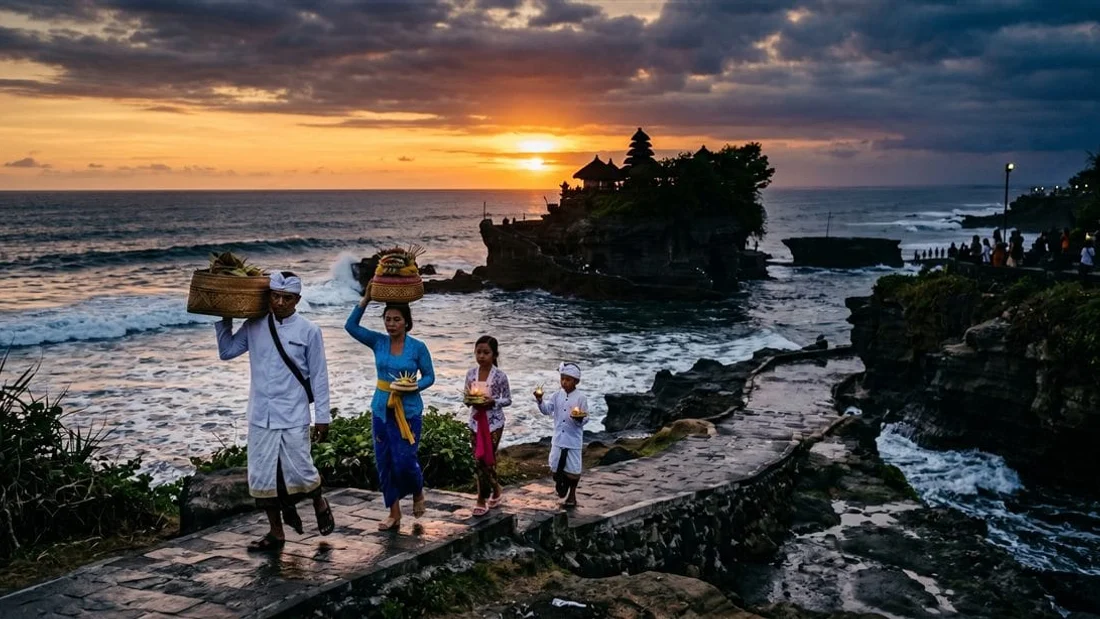
To visit a Bali temple, cover your shoulders and your knees and wear a sarong with a sash tied at the waist. A t-shirt plus a sarong over shorts is fine. Big ticketed temples such as Uluwatu hand you the sarong and sash at the gate. Smaller temples vary, so bring your own if you are going somewhere off the main circuit.
That is the whole dress code in one paragraph. The part people get wrong is what happens after the gate: the etiquette, the monkeys, the tickets that turn out to be two tickets, and the tide that decides whether Tanah Lot is a walk or a viewpoint. Below is what actually matters, which temples suit a half-day from Kuta, and what the trip costs. For the wider picture, see the things to do in Kuta and the ready-made 4-day Bali itinerary.
What to Wear to a Bali Temple
🛕 A Balinese temple, or pura, is a working place of worship, not a monument. People pray there daily, families bring offerings, and ceremonies run all year. The dress code exists for the same reason a church or a mosque has one: it signals that you understand where you are standing.
The rule is simple. Shoulders covered, knees covered, sarong on. Everything else is detail.
- Top: a t-shirt, light long-sleeve shirt or linen button-up. No singlets, no crop tops, no swimwear, nothing see-through.
- Bottom: shorts, a skirt or trousers are all fine underneath, because the sarong goes over the top and covers your knees. Long trousers do not always get you out of the sarong — some temples still want the cloth and the sash, some only the sash. That is the entrance staff's call, not yours.
- Sarong: a length of cloth wrapped around your waist to below the knee. Men and women both wear one.
- Sash (selendang): a narrow band tied around the waist over the sarong. This is the part visitors forget, and at stricter temples it is the part staff will hand you before they let you through.
- Shoes: on the public grounds you normally keep them on. Some areas, and most inner courtyards during a ceremony, are the other way round. Read the sign at the entrance and copy what the worshippers around you are doing.
Practical version for a Kuta day: wear the shorts and t-shirt you would wear anyway, throw a sarong in your bag, and you are dressed for a temple, a beach and a warung lunch without changing once. The one thing that still gets people stopped is arriving straight off the beach in a bikini top or a singlet — the loaner sarong only covers the bottom half, so bring sleeves.
Sarong and Sash: What's Provided, What to Buy
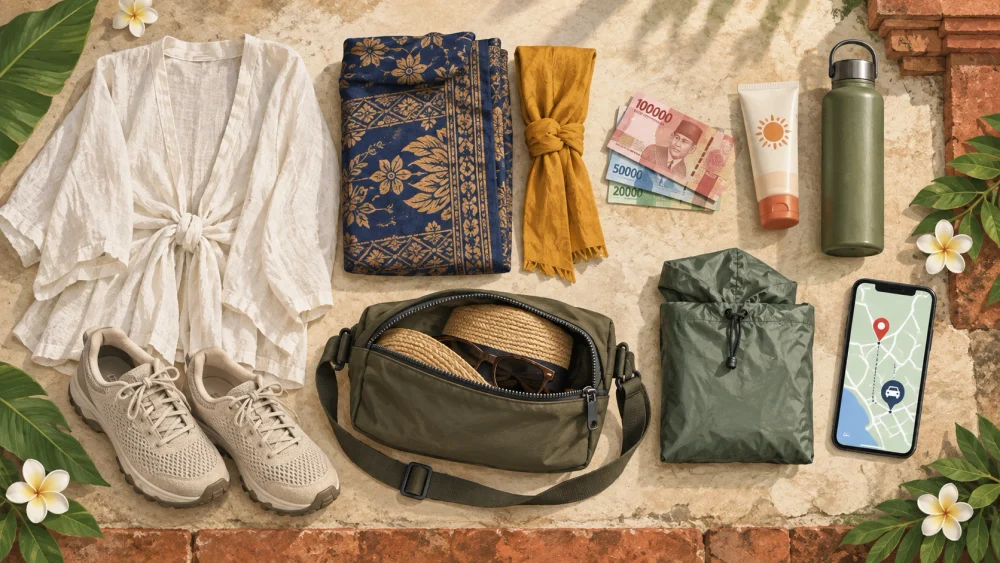
At Uluwatu the sarong and sash are handed out at the entrance at no extra cost. Elsewhere it varies more than most guides admit: some temples fold the loan into the ticket, some take a small deposit, some charge a rental, and some only give you a sash. Check the entrance signage rather than assuming. The loaners are faded, one-size and shared, which is fine if you are visiting one temple and do not care about photos.
Buying your own makes sense if you are visiting more than one temple, travelling with kids, or want a photo without a well-used loaner. What one should cost:
⚠️ Prices are indicative. Temple entry fees are reviewed periodically and market prices move with the season — always check the board at the gate.
| Where you buy | Typical price (sarong) | Verdict |
|---|---|---|
| Local market or Kuta side street | USD $3 – 6 | ✅ Best value |
| Beachwalk / mall shop | USD $8 – 12 | 🆗 Fixed price, easy |
| Stalls at the temple gate | USD $10 – 15 | ❌ Captive-audience pricing |
| Borrowed at the temple entrance | Included or small deposit | ✅ Free, but shared |
Market sarongs are negotiable. A lightweight cotton one travels best, and patterned batik is worn at temples too — buy the one you like rather than the one a stall calls "the temple one".
Planning a temple and sunset day? Send Andrew your dates — driver, tickets and timing sorted at local rates.
Plan my temple day 🤙Temple Etiquette That Actually Matters
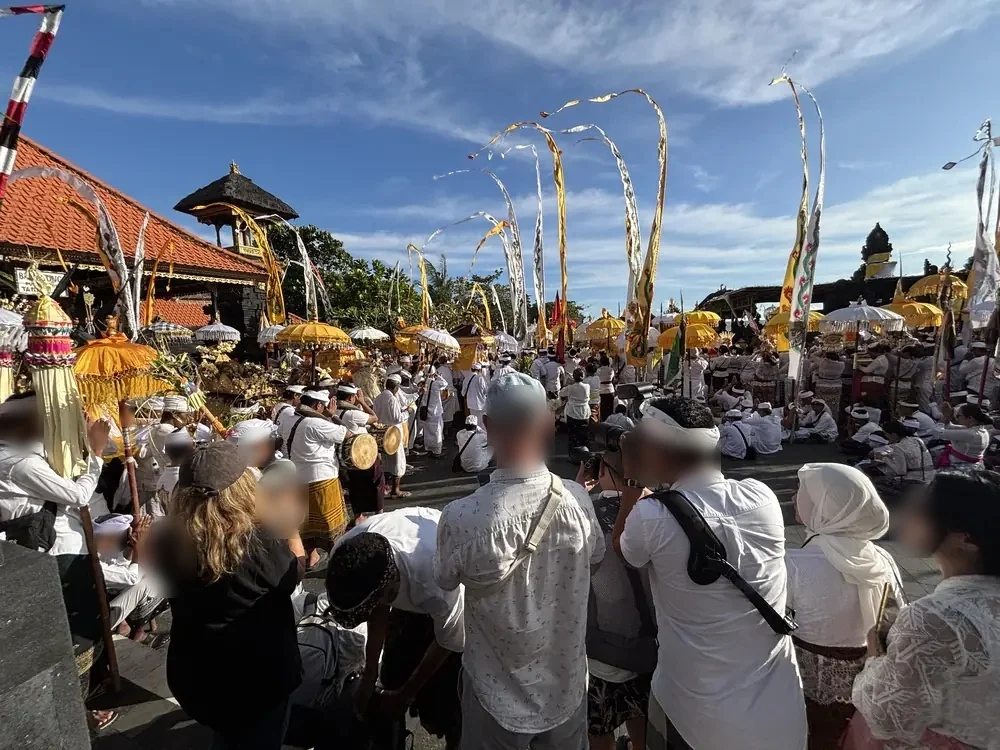
Dress gets you through the gate; behaviour is what people inside notice. Nobody expects you to know Balinese Hindu ritual — they expect you to be quiet and to watch where you walk.
- Never walk in front of someone praying. If a person is kneeling toward a shrine, go behind them. This is the single most common thing visitors do wrong.
- Don't climb on shrines, gates or walls for a photo. Sitting on a temple wall looks harmless and is not.
- Stay low during a ceremony. If a pemangku is seated and blessing people, sit or stand lower than they are, and never directly in front of the priest or the people being blessed.
- Keep your voice down and put your phone on silent. Ceremonies can start without warning.
- Ask before photographing worshippers. A gesture at your camera and a nod is enough. Most people say yes; some don't, and that's the end of it.
- Step around the offerings (canang sari) on the ground. Those small palm-leaf trays with flowers are placed deliberately.
- Don't point your feet at a shrine if you sit down, and don't point at people with your index finger.
- Temples post a purity rule asking anyone who is menstruating or actively bleeding not to enter the sacred areas. It is a religious custom, not a judgement of you, and it is observed on trust — so follow the posted rule even when nobody asks.
Best Temples to Visit from Kuta
You do not need to cross the island. Two of Bali's most famous temples are easy half-days from Kuta.

Uluwatu Temple (Pura Luhur Uluwatu) Google Maps →
From Kuta: about 45–60 minutes south by car, 60–90 in the sunset rush
Entry: roughly USD $3–5 per adult, less for children; sarong and sash provided
Kecak dance: a separate ticket, around USD $9–10, for the 6pm performance
Best time: arrive around 4pm for the cliff path, then the dance
A sea temple on a cliff about 70 metres above the Indian Ocean, with a walking path along the headland that is the real reason to come. The Kecak fire dance in the clifftop amphitheatre is timed so the sun goes down behind the performance.
- Two tickets, not one. Temple entry and the Kecak dance are sold separately, and the dance ticket does not include the temple.
- The show runs about 6pm to 7pm, with the gate and ticket window open from around 4pm. In peak season, turning up at ten to six is how people end up at the back.
- Bring local cash in small notes — the windows here work on cash, and the amphitheatre is unshaded stone steps with no assigned seats, so water and a hat you can hold are worth having.
- Agree a meeting point with your driver before you go in — the car park empties all at once when the dance ends, and times can shift for weather or ceremonies, so check the same day.
Tanah Lot Google Maps →
From Kuta: 50–65 minutes north-west when the road is moving, up to 90–120 in the late-afternoon rush
Entry: roughly USD $4–5 per adult
Best time: whichever tide you'd rather see — check it before you leave
The temple sits on a rock in the sea, and the tide decides the visit. At low tide, when conditions are safe, the rock shelf opens and you can walk to the base for the holy-water blessing at the spring. At high tide the temple stands surrounded by white water, which is the silhouette most people come to photograph.
Neither is the lesser version — they are simply two different afternoons, so check a tide chart before you pick your time. My full Tanah Lot guide covers the tide rule, the cliff temple most visitors miss, and the Melasti ceremony before Nyepi.
If you have a full day and want the interior of the island, Ubud pairs temples with rice terraces — see the Ubud day trip from Kuta. For the sunset-only version without the temple, the sunset bars in Kuta and Legian are a five-minute ride instead of an hour.
Other Temples People Ask About
Four more come up constantly when guests plan a day inland — and what's provided differs at each.
| Temple | Sarong | Worth knowing before you go |
|---|---|---|
| Tirta Empul (holy spring, near Ubud) | Provided or lent at the entrance | Sarong and sash are required on the grounds even if you don't get in the water. Joining the melukat purification is a separate thing again: you rent a bathing sarong and a locker, and you change out of it afterwards. |
| Besakih (the mother temple, east Bali) | Included with the ticket | The ticket also comes with a local guide, and there's a shuttle up to the main entrance. It's a large complex on a slope — budget more walking than a coastal temple. |
| Taman Ayun (royal temple, Mengwi) | Included with the ticket, handed over at the entrance | A walled royal temple with tiered meru towers, on the UNESCO Bali cultural landscape listing. You walk the perimeter rather than the inner courtyard, which is kept for worshippers. Easy to pair with Tanah Lot on the same drive. |
| Goa Gajah (Elephant Cave, Ubud) | Provided at the entrance | Small site, an hour is plenty. Stone steps down to the bathing pool and the cave, slippery after rain. |
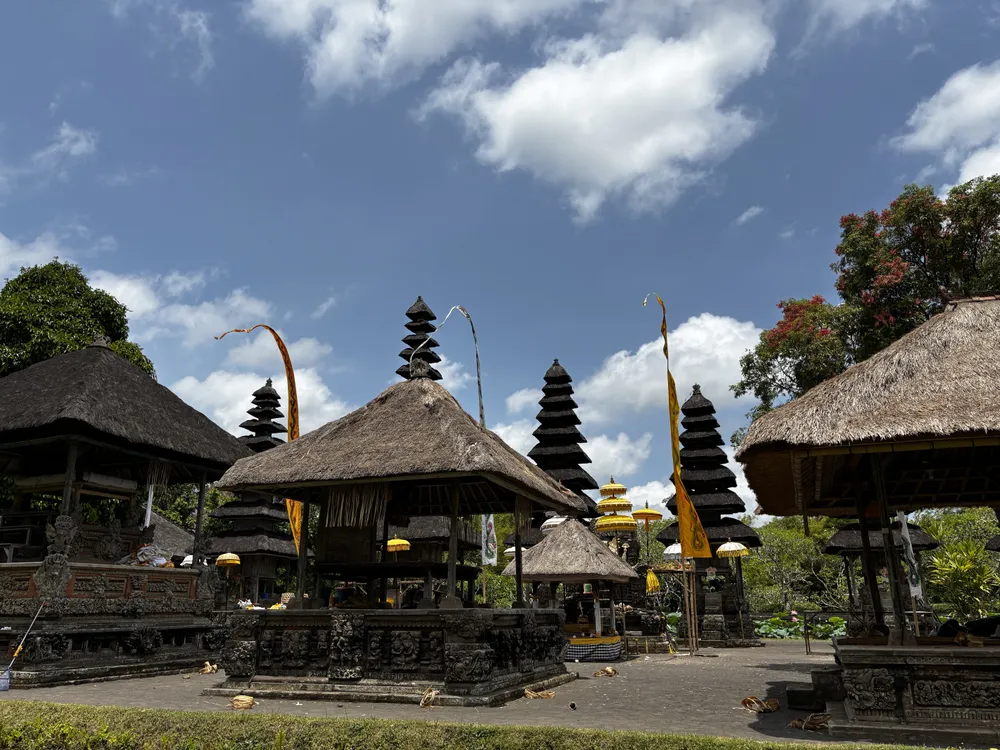
Everywhere else — the village temples you pass on a scooter — assume nothing is provided and that you may not be able to go in at all, especially during a ceremony.
Steps, Sun and Who Might Struggle
Temple visits get sold as easy sightseeing, and most involve more steps and more sun than people expect. Which parts are optional:
- Uluwatu: the clifftop path is long, uneven and almost entirely unshaded. You can see the temple from near the entrance, so the headland walk is the part to skip if heat or distance is a problem.
- The Kecak amphitheatre: stone steps, no backs, no assigned seats. Come early enough to take a low row.
- Tanah Lot: the rock shelf at low tide is wet, black and slippery, with gaps between the slabs. If your footing isn't steady, stay on the shore path.
- Prams and wheelchairs: the main walkways at both sites are manageable, the cliff path and the rock shelf are not. Plan the day around the viewpoints rather than the full circuit.
What a Temple Trip Actually Costs
Temple entry is cheap and fixed. Transport is the real cost of the day, and it's the number worth agreeing before you leave rather than after.
| What you're paying for | Price | What it covers |
|---|---|---|
| Uluwatu temple entry, adult | USD $3 – 5 | Temple grounds and the cliff path. Not the dance, not parking. |
| Uluwatu Kecak dance, adult | USD $9 – 10 | The 6pm performance only, cash at the window. Children pay less. |
| Tanah Lot entry, adult | USD $4 – 5 | The site and the shore. Parking is charged separately. |
| Driver: Kuta → Uluwatu return, with waiting | USD $30 – 40 | My rate, car and driver, waiting through the dance. |
| Full-day car and driver (temples + stops) | USD $45 – 60 | My rate for the day, your route. |
| Sarong, if you want your own | USD $3 – 6 | Market price. Gate stalls ask more. |
I work with the same drivers every week, so the route, the waiting time and the total are agreed before you get in the car, and the car waits at the car park instead of pulling out on a schedule. Whatever you book, ask those three things up front: what's included, how long the driver waits, and what happens if you stay for the whole sunset.
Andrew's Take
The temple day I actually recommend: leave Kuta by 3pm at the latest, walk the cliff headland path first while the light is still high, then take your seat for the Kecak dance about thirty minutes before it starts. That order matters. Plenty of people arrive close to showtime, and by the time the dance ends it's dark on the cliff path — they never see the thing they drove an hour for.
The second thing I push is the driver, not the tour. I use the same drivers every week and we confirm the route, the waiting time and the total before you leave, so nothing is renegotiated at the car park. The car waits while you stay for the last of the sunset instead of leaving on a fixed schedule.
On the way back, skip the restaurants on the Uluwatu road and stop at a warung on Jalan Pantai Kuta instead. If you want a full day out of it, pair the temple with a morning surf lesson at Kuta Beach — water in the morning, cliff temple at sunset.
One last thing. Wear the sarong properly, low enough to cover your knees, and tie the sash. It takes ten seconds, and it saves you being sent back to re-tie it in front of the queue.
Frequently Asked Questions
What should I wear to a Bali temple?
Cover your shoulders and your knees, and wear a sarong with a sash tied at the waist. A t-shirt or light long-sleeve top plus a sarong over shorts or a skirt is enough. Big ticketed temples such as Uluwatu hand you a sarong and sash at the entrance; elsewhere it may be included, lent for a deposit, rented, or not offered at all, so check the sign at the gate.
Can you wear shorts to a temple in Bali?
Yes, as long as you put a sarong over them so your knees are covered. Shorts on their own will get you stopped at the gate. Singlets, crop tops, swimwear and see-through cover-ups are the other common reasons people get turned back, so bring something with sleeves.
Which temples are near Kuta?
Uluwatu Temple is about 45–60 minutes south of Kuta and is famous for its clifftop setting and the Kecak fire dance at sunset. Tanah Lot, the sea temple, is 50–65 minutes north-west, longer in the sunset rush. Both are comfortable half-day trips from Kuta with a driver.
How much does it cost to visit a Bali temple?
Entry to the main temples is cheap — budget roughly USD $3–5 per adult at Uluwatu or Tanah Lot, with the Kecak dance ticket at Uluwatu costing around USD $9–10 extra. Prices are reviewed periodically, so check the board at the gate. The bigger cost is transport: a driver from Kuta to Uluwatu and back with waiting time runs about USD $30–40 at a local rate.
Are Uluwatu Temple and the Kecak dance separate tickets?
Yes. Temple entry and the Kecak performance are sold as two separate tickets, and the dance ticket does not include entry to the temple grounds. Both are paid in cash at the windows, so bring small notes.
What are the main temple etiquette rules in Bali?
Keep your voice down, never walk in front of someone who is praying, don't climb on shrines or sit on temple walls, and stay lower than the priest during a ceremony. Ask before photographing worshippers. Temples also post a rule asking anyone who is menstruating or actively bleeding not to enter the sacred areas; it is observed on trust.